

What six sell-side transactions in the first half of 2026 taught us about platforms, AI, sales, process and valuation.
In the first half of 2026, we completed six sell-side transactions involving IT managed service providers and spoke with more than 100 potential buyers. The conversations gave us a real-time view of how private equity firms and strategic acquirers are evaluating MSPs today.
Some of what we heard was expected. Growth matters. Recurring revenue matters. Management depth matters. But several of the more useful lessons were less obvious.
1. “Platform” status is not just about size
We sold an MSP with less than $10 million in revenue. That is smaller than the typical new platform acquisition, but the company had something buyers valued just as much as scale: A capable management team and processes that could support growth.
The owner was still active in the business, but the company was not overly dependent on him. It had a strong management bench, repeatable operations and a scalable go-to-market approach. We were able to demonstrate that the business could serve as the foundation for future acquisitions, not simply as an add-on.
The result was a very competitive process. The winning bidder was a private equity firm forming a new platform.
Size still matters. But buyers are also underwriting what the company can become. An MSP that is managed like a platform can earn platform consideration before it reaches conventional platform scale.
2. AI can expand the buyer universe, but buyers want proof
It is still difficult to quantify exactly how much AI adds to an MSP’s valuation. We did, however, see a noticeable increase in buyer interest when we could show how a company was using AI to improve its own operations and help its clients.
Buyers responded to tangible examples: Reducing internal labor, improving service delivery, making technicians more productive, or helping customers adopt AI responsibly. A generic statement that the company is “focused on AI” does not carry much weight. Real use cases do.
MSPs that are proactive about AI can broaden their pool of potential buyers. Over time, the best-positioned companies should also earn a valuation premium.
3. Buyers agree that AI matters. They do not agree on what it means
AI is top of mind for nearly every buyer, but there is no settled investment thesis.
A small group is cautious because it believes AI could disrupt parts of the MSP model. Most buyers see it as an opportunity, but their views differ widely. Some focus on internal efficiency. Others see new advisory and implementation revenue. Still others believe AI will increase the need for security, data infrastructure and governance.
MSP owners do not need to predict the future perfectly. They do need a point of view. A company becomes much more compelling when it can show how it is applying AI internally, what it has deployed for clients and where it believes the opportunity is headed.
The jury is still out. That is exactly why owners have an opportunity to get ahead of the market.
4. Founder-led sales are fine. Founder-only sales are not
Faster growth usually earns a higher EBITDA multiple. But buyers look closely at where that growth comes from.
Consider two MSPs: One is growing quickly because the founder personally drives nearly every new relationship; the other is growing at a more moderate pace through an established go-to-market team. Based on what we saw, buyers are often more confident underwriting the second company’s future growth.
That does not mean the founder needs to leave sales. In many MSPs, the founder remains the strongest relationship builder and the most credible voice in the room. The problem is not founder-led sales. The problem is founder-only sales.
A buyer can place greater value on the growth forecast when the sales process, pipeline and customer relationships extend beyond one person.
5. An ideal buyer is not a substitute for a competitive process
Many owners receive inbound interest from a buyer they already know and like. Sometimes that buyer ultimately is the right one. But knowing your preferred buyer does not eliminate the value of running a process.
The preferred buyer will still participate. The difference is that the buyer now has to compete. That pressure often leads to a higher price, better structure and improved terms.
There are two parts to valuing a company: what it is worth and what a specific buyer is willing to pay. Barring a competitive process, a buyer will largely bid on the former. The competitive process unveils the extent of the latter. Time and again, we have seen the same buyer pay more when they are part of a competitive process.

6. A buyer’s last bid tells you little about its next one
In one of our processes, a buyer submitted the highest bid. In another, that same buyer submitted the lowest.
That is not unusual. A buyer’s willingness to pay changes with timing, geography, cultural fit, existing portfolio exposure, integration capacity and dozens of other factors. The bidder that paid a premium for the last MSP may not be the most aggressive buyer for yours.
The buyer universe also keeps changing. New private equity firms continue to enter the sector and form platforms. A process built only around the familiar names can miss the buyer with the strongest reason to stretch.
7. Valuation is not one number
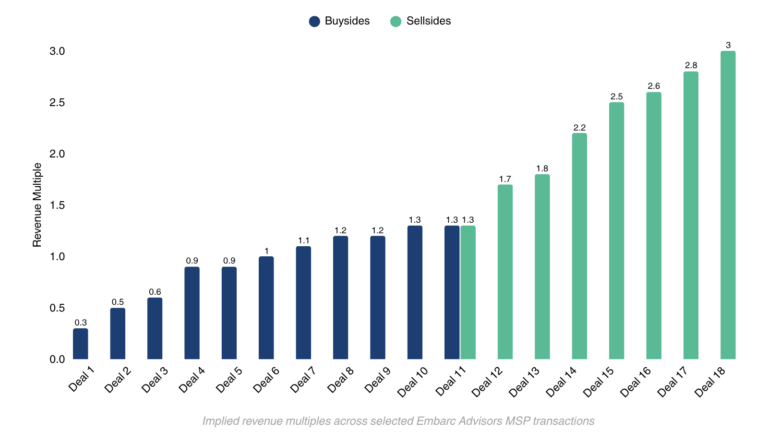
A typical process we run receives 10 to 15 bids. Those bids often land roughly two turns of EBITDA above or below the median. They also come in different forms, using different EBITDA calculations, multiples, rollover requirements and deal structures.
Every bidder may have a sophisticated finance team, but they are not all valuing the same risks and opportunities in the same way. One buyer may see a market-leading platform. Another may see an add-on that requires investment. A third may have a strategic synergy that supports a much higher price.
Valuation work can estimate what a company should be worth. Only a competitive market can show what buyers will actually pay.
8. The “best” revenue model is not the only path to a premium valuation
Fixed monthly fees and multiyear contracts are generally considered best in class for an MSP. They reduce perceived risk and make future revenue easier to underwrite.
But we also saw a high-growth, well-run MSP with no long-term contracts and a time-and-materials revenue model receive approximately a dozen bids and trade at a premium valuation.
The reason was straightforward: the company had consistent growth, stable margins and a fundamentally strong operation. Buyers recognized that quality even though the revenue model did not fit the traditional best-in-class mold.
Revenue quality matters, but it is not evaluated in isolation. Growth and risk ultimately drive valuation. A company can overcome an imperfect business model if the rest of the evidence is strong enough.
Owners often ask what multiple their MSP should command. The honest answer is that the market decides. The work before a sale is to give buyers more reasons to lean in and fewer reasons to discount the business. The work during a sale is to make sure enough of them are at the table.
Have questions about selling your business? Talk to our team.