Fortune 500-caliber fractional CFO services for growth-stage businesses between $5M and $100M in revenue. Delivered by M&A operators who know what buyers look for because they run deals every week.
Our CFO Services flex to where the work actually is. Most clients fit one of these three situations.
HIGH-GROWTH CFOs
Your CFO is buried in investor relations. The forecast model, the board deck, the monthly reporting piles up. We bring analysts who get up to speed in days and deliver the outputs your CFO needs.
Book a 15-minute capacity conversation.
OWNER-LED BUSINESSES
Your business funds your next chapter. The cleaner your books, the higher the multiple. We move owner-led $5–100M companies from intuition-driven to buyer-ready due diligence approaches.
Learn where you are today.
FINANCE TEAMS IN TRANSITION
When senior finance roles are vacant, the work doesn’t stop. We step in fast with no recruiting cycle. Your monthly close, reporting, and forecast keep moving, keeping books clean and defensible.
Schedule a confidential call to learn more.
Our CFO Services are most often a fit for businesses that look like this:
If that’s you, you’re in the gap this service was built for. If you’re earlier, pre-product-market-fit, pre-revenue, or under $5M, you’re better served by a strong bookkeeper plus a CPA until the volume justifies more. If you’re larger, $100M+ with significant scale and headcount in finance, you need a full-time CFO with a team.
How a business’s finance function should evolve as it grows
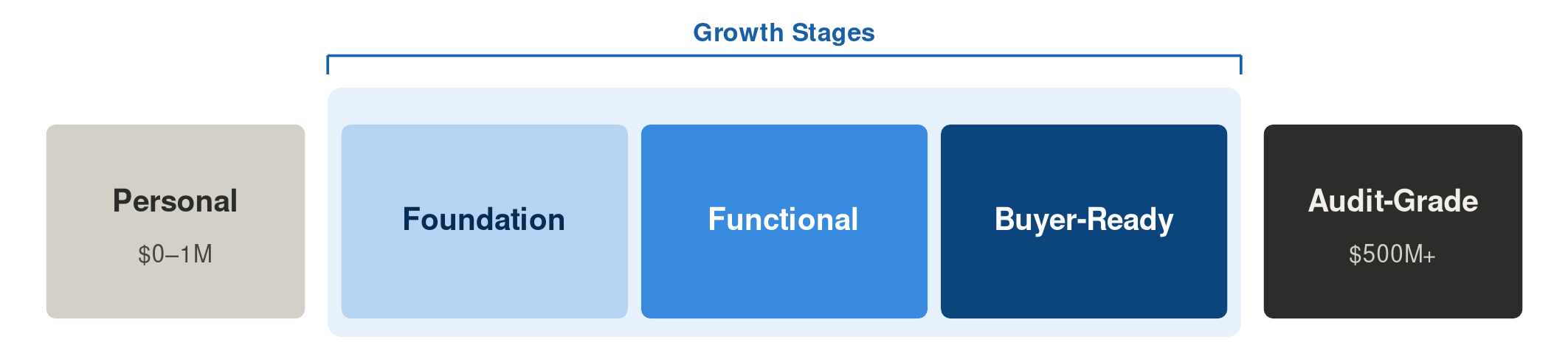
Cash basis. Personal funds mixed with business funds.
Bookkeeper-run. Tracks revenue, expenses, net. Tax-driven P&L.
EBITDA cleaned up. Personal expenses stripped. Normalized. Monthly close.
Accrual accounting. Granular measurement. Forecast drives decisions.
Full GAAP. Annual audit. Investor-grade FP&A.
Can’t tell what the business actually makes.
Owner expenses embedded. EBITDA not defensible.
Books reactive, not predictive. Decisions are still made by gut feeling.
None blocking – books would survive diligence today.
Built for institutional investors, not just buyers.
CFO Services help you upgrade your finances to build for what comes next.
The Financial Maturity Spectrum presents five stages of finance function evolution.
Most $5M–$100M businesses live in the three stages in the middle. A buyer or sophisticated investor judges your business against the upper end of the Spectrum, but most owner-led companies operate much closer to the lower end. That gap is what gets re-priced in diligence.
The three middle tiers map to how buyers actually evaluate businesses:
Books work for taxes and basic operations. Cash basis or inconsistent accrual. Close takes weeks, if it happens at all. KPIs aren’t tracked. The owner runs the business off bank balance and gut. EBITDA isn’t normalized; personal expenses still live in the P&L. A buyer walks away or values aggressively.
Accrual basis is mostly there. Close happens on a schedule. A handful of KPIs are tracked. There’s a budget. EBITDA has been cleaned up, personal expenses stripped out, and normalization done. There’s enough visibility to make decisions, but the documentation isn’t ready for diligence. A buyer can work with this, but expect questions, adjustment requests, and friction on add-backs.
Accrual is rigorous. Close happens within 10 business days. KPIs are tracked, reported monthly, and compared to plan. Add-backs are documented as they happen, not reconstructed later. Cap table is current. Cash forecast starts at 13 weeks and extends to over a year. A buyer reads your package and sees no red flags, and sees a level of business maturity that potentially commands premium valuations.
CFO Services moves you up the spectrum from where you are today to where you need to be to hit your next milestone. That may be Foundation to Functional, Functional to Buyer-Ready, or tightening an already-Buyer-Ready operation before a process.
Want to know where you currently sit on the Spectrum? Take the 5-minute Diligence-Readiness Self-Assessment consisting of 10 questions, and scored against the same criteria a buyer would apply. You’ll get a personalized report with your tier and the five highest-leverage items to fix.
Take the Diligence-Readiness Self-Assessment →

Head of Strategic Finance
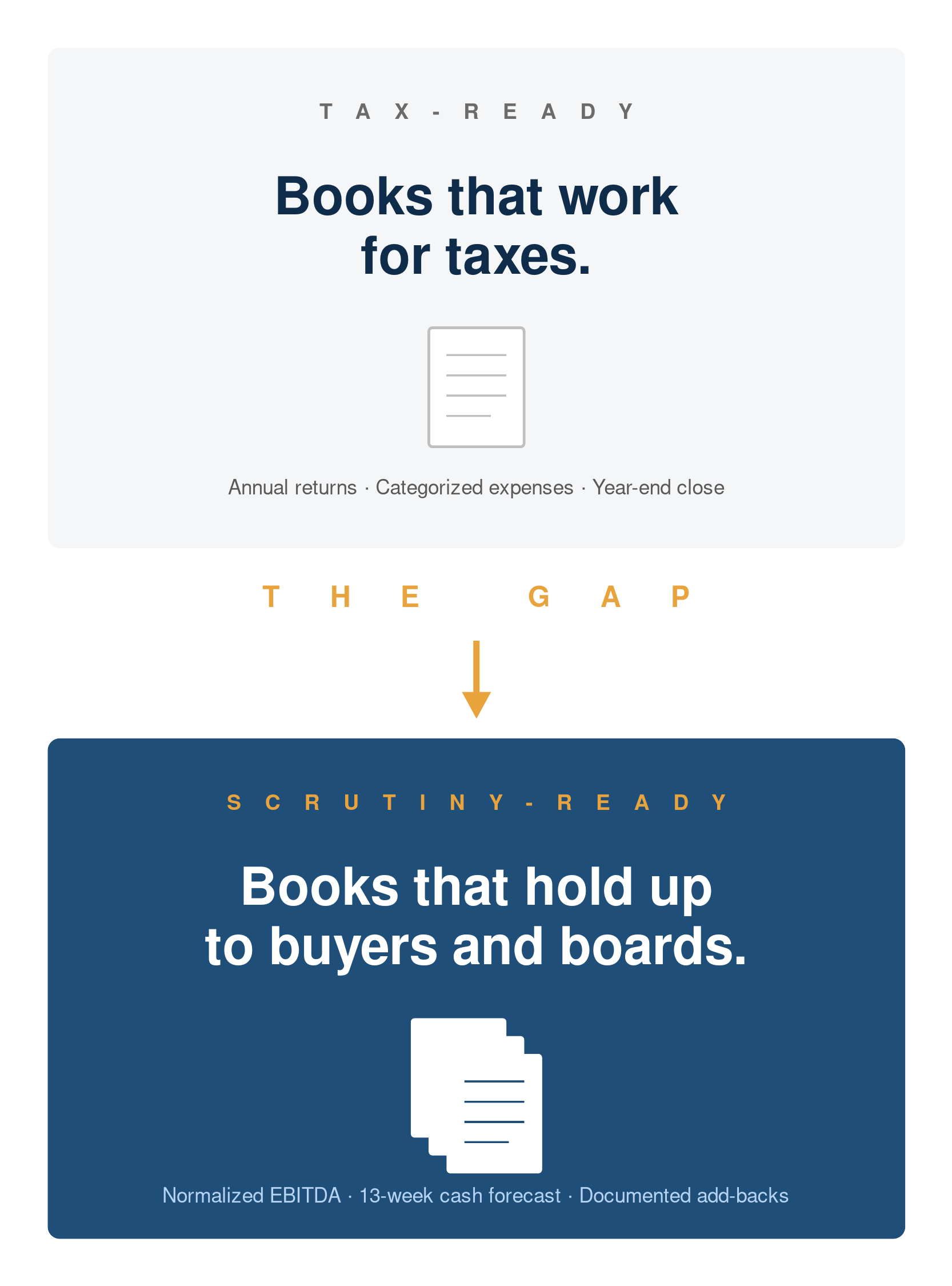
Owner-led businesses face one version of the gap. Growth-stage CFOs face another. The underlying issue is the same: A finance function that can’t keep up with the next stage.
Most owner-led businesses outgrow their finance function before they realize it. A bookkeeper handles transactions. A CPA files taxes. Maybe a controller runs the close. The lights stay on. The books work for day-to-day operations.
But “the books work” is not the same thing as “the books would hold up under scrutiny.” Those are two different standards. You almost never find out which one your books meet until a buyer, a lender, or a board asks for documentation you’ve never been asked for before.
By that point, the cost of getting ready is materially higher than it would have been if you’d built to that standard a year or two earlier. Add-backs get harder to defend. Revenue recognition gets unwound. EBITDA gets re-cut. Multiples compress.
This page is about closing that gap before it becomes expensive.
Every engagement starts with a diagnostic, not a sales pitch. We need to know what your business pain points are.
Every engagement is shaped around what you need. Some clients run through all four. Others stay in one or two and stop. You decide what’s worth engaging on.
Head of Strategic Finance
“Growth-stage CFOs don’t fall behind on the work alone. They fall behind on their relationships. The engineering head can’t get a headcount call. The CMO can’t get budget moved. The product lead can’t get capex approved. We give the CFO their time back, so they can be in the room when those calls happen.”
High-Growth CFOs
Owner-Led Businesses
Finance Teams in Transition

Why Strategic Finance is the Growth Lever Most Companies Ignore
Most companies treat finance as a cost center. The ones that grow fastest treat it as a strategic edge. Here’s the difference, and what it looks like in practice.
The Strategic Finance Playbook: A Proven 7-Step Process to Maximizing Value
A practical framework for building a finance function that scales with your business. How to move from compliance-driven books to decision-driven ones.

7 Common Accounting Mistakes That Quietly Erode Your Enterprise Value
The bookkeeping decisions that don’t matter for taxes can cost you seven figures in a sale. These are the patterns we see in nearly every diligence engagement.
A controller manages the close and the books. A bookkeeper records transactions. A controller and bookkeeper only look back. A CFO interprets the financial results and looks forward to support financial and strategic decisions.
Marketplaces aggregate individual contractors. You get one person whose background is whatever it is. Embarc Advisors is a team of financial operators skilled across the financial spectrum. When you hire us, you get a primary CFO plus access to a broader strategic bench: M&A, FP&A, quality of earnings, capital raise. The bench shows up when your situation needs it.
Embarc Advisors can step in and support your CFO on a variety of functions that they might not have time for, such as managing the monthly financial close, business partnering with department heads, and assisting in board deck preparation, and ad hoc analysis to support strategic decisions. That way your CFO can concentrate on the functions important to your company at its current stage, such as fundraising, investor outreach, and lender discussions, etc.
We typically ramp up within the first week and start delivering outputs and insights going forward.
We scope at the start. Most engagements begin with an initial review of your books before we recommend a level of effort.
Yes. This is one of our most common engagement types. PE-backed portfolio companies between $5M and $100M in revenue typically need CFO-level support but aren’t ready for a full-time hire. We work with the operating team, the sponsor, and the board.
Definitely. We’ve been on both sides of deals: Sell-side and buy-side. We know what the diligence process entails, what buyers ask, and what transaction-ready financials look like. If you’re considering a transaction in the next 12–36 months, that’s the right time to engage.
That’s normal. Most engagements start with cleanup. We’d rather start there than walk into diligence with you and find it then.
Engagements vary by what you need. Some clients run through the full sequence: Initial review, foundation, decision support, strategic finance. Others stay in one phase and stop. We scope at the start and rescope as the work changes. Some clients work with us for years across multiple transactions. Others engage us for one specific event and we wind down.
Yes, always, before any work begins.
© 2026 Embarc Advisors. All Rights Reserved | Terms of Use | Privacy Policy | Google Privacy Policy | Google Terms of Service

