

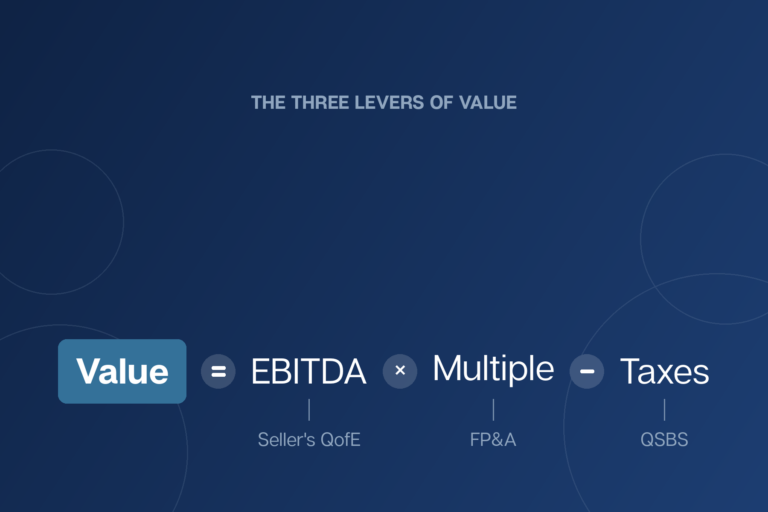
Most MSP owners focus on the EBITDA multiple. That is only half of the valuation story.
Ask an MSP owner what the business is worth and the answer usually starts with an EBITDA multiple. The shorthand often sounds like this: A company with $1 million of EBITDA may trade around 8x; a company with $2 million may trade around 10x, and so forth.
That is a useful reference point, but it leaves out an important question: What if the EBITDA potential has not fully materialized.
Revenue multiples are usually associated with software companies. They matter for MSPs as well – not because buyers will necessarily bid on revenue, but because the implied revenue multiple shows how effectively a company turns revenue into enterprise value. It also exposes how much value an owner may still be leaving on the table.
The same revenue can produce very different outcomes
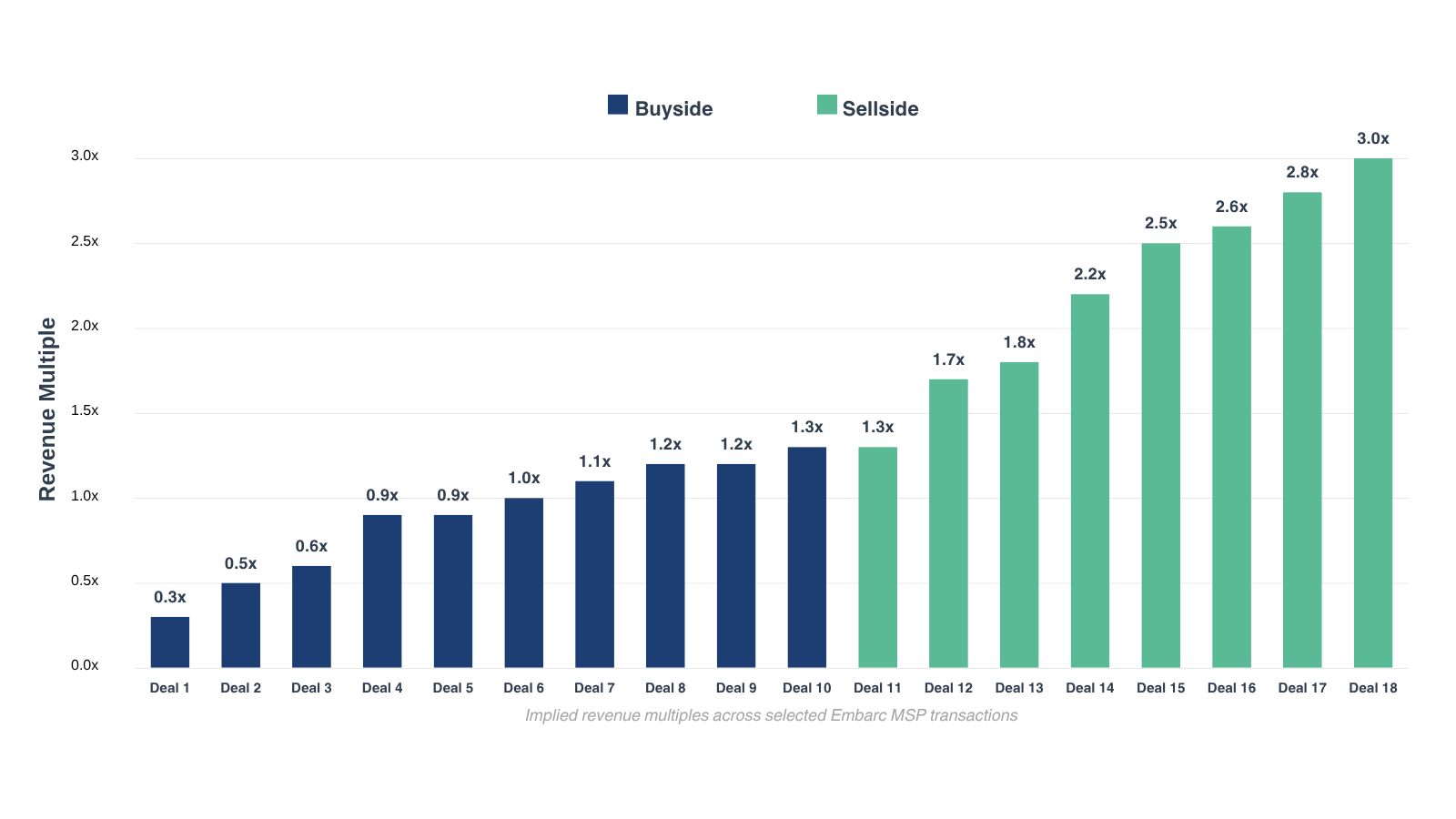
The chart below shows the implied revenue multiples from 18 MSP transactions in which Embarc advised either the buyer or the seller. Enterprise value divided by annual revenue ranged from 0.3x to 3.0x. The spread was not explained by EBITDA size alone. Deal 11 through Deal 18 represent IT MSPs with $0.5M in EBITDA up to $5M in EBITDA, and the highest revenue multiple was not a $5M EBITDA business.s.
Consider a $7 million revenue MSP. Depending on its cost structure and operational discipline, that company could generate $1.0 million, $1.5 million, $2.0 million or $2.5 million of EBITDA. As EBITDA grows, the company may benefit twice: There is more EBITDA to sell, and the multiple applied to that EBITDA may also rise.
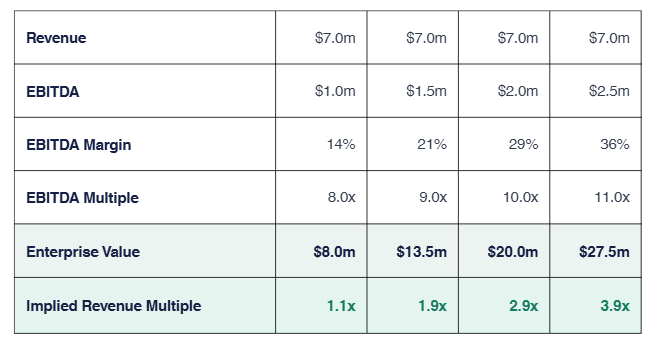
In this illustration, enterprise value increases from $8.0 million to $27.5 million even though revenue never changes. The implied revenue multiple moves from 1.1x to 3.9x.
There is no universal margin that guarantees a 2x revenue valuation. Growth, recurring revenue, customer concentration, service mix, management depth, and buyer demand all matter. But the basic math is hard to ignore: For a business valued primarily on EBITDA, a stronger margin is usually the most direct path to a stronger implied revenue multiple.
EBITDA improvement creates leverage twice
Many owners treat current EBITDA as a fixed characteristic of the business. However, just like any other financial metric, it can be improved with focused, deliberate effort. With six to 12 months of preparation, an MSP can often improve profitability in ways that are both sustainable and defensible to a buyer.
The value creation works in two places:
- Every additional dollar of adjusted EBITDA is multiplied by the valuation multiple. At 9x, $100,000 of incremental EBITDA can create $900,000 of enterprise value.
- Higher EBITDA and a stronger margin can improve the company’s overall quality and support a higher multiple.
That is why small changes matter late in the ownership cycle. Saving $10,000 here and $20,000 there may feel immaterial during normal operations. In a sale, those savings can be worth eight to 10 times as much, if they are real, recurring and properly documented.
Some say that the multiple does not expand 25% EBITDA margin. Our experience in the market begs to differ.
Where MSP owners can find the improvement
1. Review gross margin by customer
Not all revenue is created equal. We once advised an MSP client not to renew one of its largest customers. The contract contributed meaningful monthly recurring revenue, but it was unprofitable to service the account.
We planned the exit from the account and filled the capacity with project work while new MRR caught up. The company went to market seven months later. Buyers saw a more profitable business, and not one of them focused on the lost customer.
Monitoring contribution margin by customer allows the business to deliberately assess whether they will improve the relationship, keep it as-is, or drop the relationship in a systematic manner.
2. Analyze utilization and staffing
Headcount is often the largest cost in an MSP, and staffing models vary more than owners realize. We recently sold a $1.6 million revenue MSP with three employees. We also helped acquire a $1.7 million revenue MSP with eight.
Those numbers do not prove that one company was properly staffed and the other was not. They do show why owners should examine technician utilization, management layers, service delivery standards and revenue per employee before assuming the current team structure is necessary.
3. Revisit vendor and overhead costs
Insurance, software tools, outsourced services, benefits and PEO fees tend to accumulate over time. Review each contract, eliminate duplicate tools and renegotiate costs that no longer reflect the company’s scale.
We once had a client that did not revisit their PEO per employee cost for over 10 years while they grew in magnitudes. The adjustment was tens of thousands of dollars on an annualized basis. Now, multiply that by 8 to 12x.
If a savings initiative is completed shortly before a sale, a buyer may give full-year run-rate credit. But the adjustment must be credible. Signed contracts, invoices, payroll records and a clear implementation date are far more persuasive than a management estimate.
4. Stop funding marketing that has not worked
Growth-oriented companies should experiment. The mistake is allowing failed experiments to become permanent expenses. Before a sale, keep the channels that produce measurable returns and stop the ones that do not.
5. Right-size the organization
This is usually the most difficult decision. Some owners will decide that reducing headcount is not consistent with their values or priorities, and that is a legitimate choice. Others may find that roles have become redundant or that the business is carrying capacity it no longer needs. The decision should be made deliberately – not discovered by the buyer during diligence. The buyer will take the action anyway and reap the rewards.
A seller’s Quality of Earnings makes the case credible
Operational improvement is only valuable in a transaction if the buyer believes it. A seller’s Quality of Earnings analysis bridges that gap by separating reported earnings from normalized, ongoing earnings and supporting the adjustments with evidence.
Common adjustments may include:
- Documented run-rate savings already implemented
- One-time CRM, ERP or other systems implementation costs
- Marketing tests that have ended and will not recur
- Compensation for positions eliminated and not expected to be replaced
- Temporary duplicate costs during a transition
- Owner-related expenses that will not continue under new ownership
A QofE is not a blank check for aggressive add-backs. Buyers will reject adjustments that are vague, unsupported or likely to recur. Done properly, however, it gives the seller a disciplined way to receive credit for the earnings power the buyer is actually acquiring.
Use the revenue multiple as a diagnostic
Most MSP owners already have a rough sense of the EBITDA multiple a company of their size and quality may command. Use that estimate to calculate the implied revenue multiple:
| Implied Revenue Multiple = (Adjusted EBITDA × Expected EBITDA Multiple) ÷ Revenue |
If the result is below 1.5x, do not assume the market has simply assigned your company a low revenue multiple. Ask why the business is converting so little of its revenue into enterprise value. The answer may be margin, but it could also be revenue quality, concentration, growth or risk.
This calculation is not a substitute for a valuation. It is a diagnostic. If you feel like you are going to end up on the left hand of the chart, it’s probably worth probing into why that is and what you can do to improve your position.
The CFO’s role in exit planning
A good CFO does more than close the books. The CFO’s ultimate goal is to maximize value of the owners. All of the analysis and forecasting is geared towards helping the management team operate better, improve value and maximize the exit outcome.
When we built Embarc’s CFO Services group, we hired finance leaders from private equity portfolio companies and public companies. EBITDA optimization and the documentation required to defend it are second nature to them.
Even in a company that has operated for 20 years, the final six to 12 months before a sale can have an outsized effect on value. That window is long enough to make real changes, show that they are sustainable and enter the market with clean support for adjusted EBITDA.
The bottom line
MSPs are usually valued on EBITDA, but revenue multiples still matter. They show how efficiently the business converts revenue into value and provide a simple way to test whether the company is ready for market.
Do not wait until the buyer’s Quality of Earnings to find out what could have been fixed. Start early, improve the economics of the business and document each change as if a buyer will challenge it—because the buyer will.
Embarc Advisors has helped dozens of IT managed service providers prepare for and execute successful exits with outstanding outcomes. If a sale may be one to three years away, contact our team to discuss where preparation could create the most value.
Have questions about selling your business? Talk to our team.