
Most business owners think about finance when something goes wrong. Here’s why that’s the wrong approach and what to do instead.
When a private equity firm acquires a company, the very first move they make isn’t to hire a new head of sales or a marketing director. It’s to install a CFO. That single fact tells you everything about how sophisticated operators think about growth.
For most privately held businesses, finance is treated as a back-office function. The bookkeeper keeps the records. The CPA files the taxes. And the owner checks the bank balance when things feel tight. It’s reactive, it’s fragmented, and it’s quietly holding the business back.
Strategic finance is something different entirely. It’s the practice of using financial data proactively to drive decisions, allocate resources intelligently, and build a business that’s worth something when it’s time to scale, raise capital, or sell.
The difference between bookkeeping and strategic finance
It’s a distinction worth making clearly, because many owners conflate the two. A bookkeeper records what happened. An accountant ensures it’s accurate and compliant. But a strategic finance function, led by a CFO or a fractional equivalent, asks a different set of questions entirely:
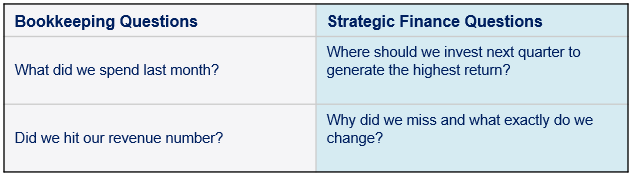
That shift in framing, from reporting to reasoning, is what separates companies that plateau from those that compound.
Why most growing companies avoid it
The honest answer is that it feels like a luxury. When you’re in the middle of running a business, the idea of building out financial infrastructure can feel like overhead. Something you’ll get to when things slow down.
But things rarely slow down. And the absence of that infrastructure means every decision gets made in the dark. Hiring decisions. Pricing decisions. Expansion decisions. All made on instinct because the numbers aren’t clean enough, or timely enough, to actually inform the call.
In periods of abundance, this can go unnoticed. Revenue is growing, the bank account looks healthy, and the business feels like it’s working. But the cracks appear when growth stalls, margins compress, or a key customer churns. Suddenly there’s no visibility, no plan, and no clear path forward.
The real cost of reactive finance
Without proactive financial management, every capital decision is made without visibility. That means companies leave money on the table, make hires too late or too early, and arrive at fundraising or sale conversations unprepared, often trading at a discount as a result.
The CFO role, redefined
This is where the role of a Chief Financial Officer, or a fractional CFO, becomes transformative. And it’s worth clarifying what that role actually is, because it’s widely misunderstood.
A CFO is not a bookkeeper. They’re not there to reconcile accounts or file returns. The CFO’s job is to increase the value of the company. They provide the financial architecture that allows the CEO to make better decisions faster. They put numbers behind the vision. They measure what’s working, flag what isn’t, and model what’s possible.
For growth-stage companies, that partnership between CEO and CFO is often the difference between spinning wheels and real momentum.
A framework for getting there
The good news is that implementing strategic finance doesn’t require a complete organizational overhaul. It follows a logical, sequential process that any business can work through regardless of size or industry.
It starts with the basics: getting your financial systems clean and reliable. Then it moves to process improvements that free up management time and provide cash flow visibility. From there, it’s about measurement, knowing which metrics actually matter at your stage of growth, and building a credible plan that the whole organization can execute against.
Done in sequence, these steps build on each other. Each one makes the next one easier. And collectively, they create the financial foundation that allows a company to make bold strategic moves, including major hires, capital raises, and acquisitions, with confidence rather than guesswork.
The 7-step framework at a glance
- Set a strong financial foundation
- Upgrade financial processes
- Establish the right KPIs
- Develop a credible budget and forecast
- Implement monthly reporting
- Align the organization for growth
- Make big strategic moves
This post is the first in an eight-part series walking through each step in detail. You can read the full series here:
- How To Build a Financial Foundation That Actually Supports Growth
- The Cash Flow Visibility Problem and How to Fix It
- The KPI Ladder: What to Measure at Every Stage of Growth
- Why Your Budget is Useless Without a Credible Forecast
- The Monthly Reporting Habit that Separates Growing Companies from Stagnant Ones
- Is You’re Organization Actually Built for the Growth You’re Planning?
- When to Make Big Moves: A Strategic Finance Checklist
with more posts coming soon.
The discipline problem
Here’s the thing most business owners already know but don’t always admit: the knowledge of what good finance looks like isn’t the hard part. Most leaders know they should have cleaner books, better forecasting, and more visibility into cash flow. The problem is execution.
It’s the same reason most people know what it takes to get healthy. Eat well, exercise consistently, sleep enough. But knowing what to do and actually doing it are different problems entirely. Running a business is relentless, and financial infrastructure is easy to deprioritize when the day-to-day is loud.
That’s where having the right partner, someone who has done this across dozens of companies and can hold the organization accountable, makes the difference between stagnation and breakthrough.
This introduction is the first blog in an 8-part series. To read Step 1 of the Strategic Finance Framework, read, How to Build a Financial Foundation that Actually Supports Growth.
Want the full framework?
Download the Embarc Advisors Strategic Finance Playbook for the complete 7-step process, including templates, best practices, and real-world examples to help you build a finance function that drives growth.
Ready to pursue breakthrough growth?