
Knowing your bank balance isn’t the same as understanding your cash flow. Here’s how to close that gap and take back control of how your business spends and plans.
Many businesses operate with all their cash sitting in a single bank account and little to no visibility into where and when it’s going. When a shortfall hits, they scramble to find a way to finance the gap. But there’s a better way — one that’s proactive rather than reactive, and strategic rather than stressful.
With a clean financial foundation in place from Step One in this series, Step Two of the strategic finance framework turns attention toward process improvement. The goal here is straightforward: free up owner and management time, and build real visibility into cash flow. Both of those things sound simple. Neither of them happens by accident.
This step covers three areas: upgrading your Accounts Payable (AP) process, improving how you manage and forecast cash, and rethinking your treasury setup. Together they shift your business from a reactive cash management posture to a proactive one.
Upgrading your accounts payable process
The typical accounts payable setup at a growing business looks something like this: paper checks, a single corporate card that everyone uses, and a general sense of unease about how much cash needs to be in the account at any given time. It’s slow, it’s opaque, and it quietly consumes far more management time than it should.
An upgraded AP process changes all three of those things. The target state is a bill approval workflow that takes less than 15 minutes, department-specific credit cards with individual spending controls, and clear weekly visibility into what’s going out and when.
Getting there starts with the right automation tool. Platforms like Bill.com, Ramp, Airbase, or Tipalti digitize invoice processing and payments, and allow you to build approval workflows that define exactly who submits, who approves, and who pays. From there, setting up ACH or electronic payment options and issuing department-specific cards with account-level spending limits rounds out the upgrade.

The time savings alone make this worth doing. But the bigger return is the visibility and control it creates — both of which are prerequisites for everything that comes later in the framework.
Building real cash flow visibility
Cash flow anxiety is one of the most common — and most avoidable — problems in growing businesses. The antidote isn’t more cash. It’s more visibility. Specifically, a rolling 13-week cash flow forecast that tracks expected inflows and outflows on a weekly basis.
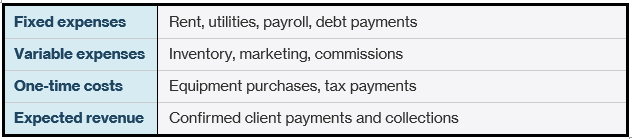
The mechanics are straightforward. Map out your expected inflows — client payments, accounts receivable collections, loan proceeds — alongside your expected outflows, organized into four categories:
Tools like Float, Pulse, or Dryrun can automate much of the tracking. But the discipline of reviewing and updating the forecast every week — reconciling actuals against projections and adjusting for emerging trends — is what makes it genuinely useful.
The result is that you see shortfalls before they happen instead of discovering them after the fact. That changes the nature of every financial decision you make. Instead of reacting to problems, you’re planning around them.
Rethinking your treasury setup
If your business operates out of a single bank account with no strategy for maximizing interest income or managing liquidity, it’s time to revisit your treasury setup. This doesn’t require a team of specialists — it requires a few deliberate decisions.
Start by diversifying across multiple bank accounts. The collapse of Silicon Valley Bank in 2023 was a stark reminder of what can happen when a business keeps all of its funds in one place. Spreading deposits across institutions mitigates that risk and keeps cash accessible when you need it.
From there, consider putting idle cash to work in a money market fund to generate interest income, and establish a line of credit for short-term working capital needs. A line of credit isn’t a sign of financial weakness — it’s a tool for smoothing out the natural peaks and valleys in cash flow without disrupting operations.
Key Takeaway!
The right tools in the right places make managing finances easier and more effective. Automation, streamlined workflows, diversified bank accounts, and a line of credit collectively position your business to make strategic decisions — rather than reactive ones.
Why process upgrades compound over time
The improvements in this step aren’t just operational — they’re strategic. Every hour freed up from manual AP tasks is an hour that can go toward higher-value work. Every week of cash flow visibility reduces the likelihood of a decision made on incomplete information. Every dollar sitting in a money market fund rather than an idle checking account is working harder for the business.
And critically, these process upgrades set the stage for what comes next: establishing the right KPIs and building a credible budget and forecast. You can’t measure what you can’t see — and after this step, you’ll finally be able to see it.
Check out Step 3 in the Strategic Finance Framework: The KPI Ladder, or get the full e-book below.
Missed the first blog in the series? Learn Why Strategic Finance is the Growth Lever Most Companies Ignore.
Ready to pursue breakthrough growth?