
Published 7/20/2023 | Updated 10/26/2026
When an IT services owner asks me what their business is worth, they usually expect me to start with EBITDA. I do, eventually. But it’s rarely the number that decides why one MSP gets a much better offer than another.
IT services is still one of the most active corners of the M&A market. Private equity firms and strategic buyers keep looking for well-run managed service providers, because the model runs on recurring revenue and long customer relationships. That’s good news for sellers. It also means buyers have plenty of companies to compare you with.
When we take an IT services company to market, the first page of its story usually comes down to eight metrics. Here’s what they are, how buyers read them, and what you can do about each one before you sell.
Quick Answer: What Metrics Matter Most When Selling an IT Services Company?
Buyers value an IT services company on eight core metrics: revenue growth, recurring revenue as a share of total revenue, customer retention, net dollar retention, gross margin by service line, adjusted EBITDA, customer concentration, and customer tenure. EBITDA sets the baseline. The other seven largely decide the multiple a buyer is willing to pay on it.
In this article
- Why isn’t EBITDA enough to value an MSP?
- What are the 8 metrics buyers look at?
- How do buyers use these metrics together?
- What should you do if you’re not selling yet?
- Frequently asked questions
Why Isn’t EBITDA Enough to Value an MSP?
Because EBITDA tells a buyer what the business earns today. It doesn’t tell them how safe those earnings are or how fast they’ll grow.
A lot of owners value their business with a simple rule of thumb: EBITDA times a multiple they heard from a peer. That’s not wrong as a starting point. Larger companies with more EBITDA generally earn higher multiples, and companies that can serve as a platform often earn a premium.
Platform: the first company a private equity firm buys in a sector, which it then grows by acquiring smaller add-on companies. Because the platform anchors the whole strategy, buyers often pay more for it.
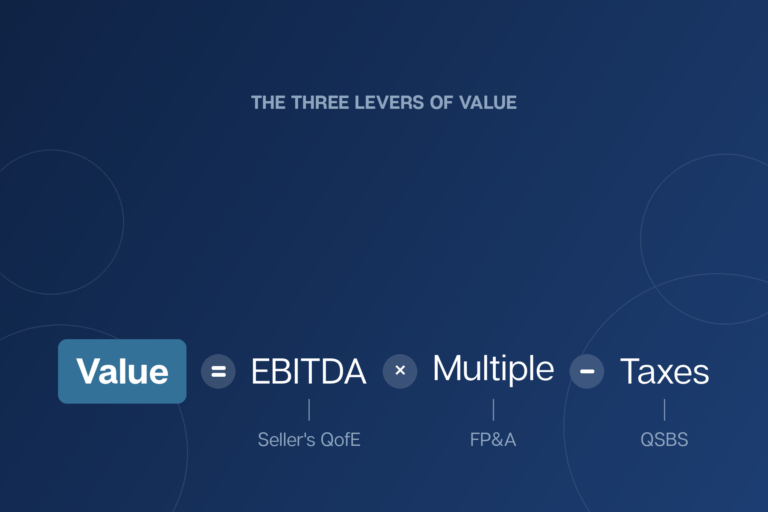
But valuation is more nuanced than that. Two MSPs with similar earnings can get very different offers, because the multiple reflects risk and growth, and that’s exactly what the other seven metrics measure. It’s the same equation we walk through in how to maximize your business’s value before you sell: EBITDA times a multiple, minus taxes. These metrics are how an IT services company moves the multiple.
Here’s how wide the range can be. One company we worked with received 11 bids. The median was six times EBITDA, but individual offers ran from 3.6 times to 8.2 times. One of the biggest mistakes I see is an owner hearing the market-average multiple, getting it, and stopping there. The right buyer, shown the right numbers, may pay well above it.
Many of our team members come from private equity, so we’ve seen how these firms evaluate opportunities from the inside. When it comes to M&A, it’s not just about growing EBITDA. How you grow it makes a big difference in the result.
What Are the 8 Metrics Buyers Look At?
Growth, stability, and profitability. Each metric below tells a buyer something about one of the three.
1. Revenue growth
Growth drives multiples, in IT services and in almost every other industry. Buyers pay for what the business will do next, not just what it has already done. An above-market growth rate also tells them you’re winning share and have room to keep going.
What to do now: Separate organic growth from growth that came through acquisitions, and show it by service line. Buyers will ask for both.
2. Recurring revenue as a share of total revenue
Recurring revenue: revenue from ongoing contracts that renew or extend on a regular schedule, like managed services agreements, rather than one-time sales.
Stability is the other big driver of multiples. It’s the same reason pipelines and utilities trade at high multiples despite slow growth: buyers can count on the cash flow.
In an MSP, that means separating contracted managed services from project work, like a custom development or infrastructure build. Revenue that repeats without a formal contract, such as a client that hires you for similar projects every year, still earns credit. It just counts for less than revenue under contract.
How to calculate it: Recurring revenue over the last 12 months divided by total revenue for the same period.
3. Customer retention rate
Retention tells a buyer whether customers think your service is worth what they pay. A high rate signals quality service at the right price, and it makes the recurring revenue more believable.
How to calculate it: Customers at the end of a period who were also customers at the start, divided by the number of customers at the start.
4. Net dollar retention
Net dollar retention (NDR): this year’s revenue from customers you had a year ago, divided by what those same customers paid a year ago. It counts upsells and expansions, minus downgrades and churn.
Retention counts customers. NDR counts dollars, which makes it a mix of stability and growth. A rate above 100 percent means your existing customers are spending more each year, which shows strong account management and the ability to cross-sell services like cybersecurity.
A strong NDR can make up for a retention rate that’s only average, because the customers who stay are growing.
5. Gross margin by service line
Buyers want to see profitability by what you sell, not just in total. For a typical MSP, that usually means three lines:
- Managed services and help desk
- Cybersecurity
- Product resale, such as Microsoft 365
Here’s why it matters. As a company grows, operating expenses usually grow more slowly than revenue, so operating margin expands. Gross margin tends to stay put unless you take specific action, like raising prices or restructuring labor costs. That makes it a good read on long-term value creation.
What to do now: Allocate technician time to each line and book resale separately, so you can show where you really make money.
6. Adjusted EBITDA
Yes, EBITDA still matters. It’s just not the only thing that matters.
Adjusted EBITDA: earnings before interest, taxes, depreciation, and amortization, adjusted to remove one-time, owner-related, and other expenses that won’t continue under new ownership. It shows what the business earns on a normalized basis.
Common adjustments include owner expenses, restructuring charges, stock-based compensation, and other one-time costs. Buyers apply their multiple to this number, so every documented adjustment counts. That’s why many sellers do their own Quality of Earnings before going to market, instead of leaving the number entirely to the buyer’s team.
If you don’t do your own QofE, you don’t really know your adjusted EBITDA. It’s like selling a house without knowing the square footage. As I told CRN after speaking at XChange NexGen, a full seller’s QofE could add as much as 35 percent to EBITDA by catching add-backs a seller would otherwise miss. It also matters after the LOI: a gap between the seller’s EBITDA and the buyer’s is one of the top reasons deals fall apart at that stage.
7. Customer concentration
Concentration measures how much of your revenue depends on a few customers. The more weight on one relationship, the more a buyer worries about losing it, especially during the transition to new ownership.
Many founder-led companies have some concentration, often because one anchor customer helped the business get started. That’s normal. What matters is having a clear story about the risk and how you’re reducing it.
How to calculate it: Revenue from your largest customer, and from your top 10, as a share of total revenue.
8. Customer tenure
Tenure measures how long customers stay with you. In a business built on long-term, mission-critical services, loyal customers are a sign of stability, and they help offset concentration risk. Short tenure, or high churn, raises the cost of winning new customers and can point to service problems.
Fast-growing companies often have a short average tenure simply because so many customers are new. In that case, pairing tenure with a cohort analysis shows both strengths at once.
Cohort analysis: tracking groups of customers by the year they signed, to see how each group’s retention and spending change over time.
How Do Buyers Use These Metrics Together?
They’re looking for a story the numbers support: a sticky revenue base, steady growth, loyal customers, and a profitable model. Sellers who can show all four get more offers, on better terms, than sellers who can’t.
Beyond these eight, buyers increasingly ask for more proof. On the risk side, that means multiyear contracts and employee tenure, not just customer retention. On the growth side, it means pipeline numbers like new leads per month, average revenue per deal, and close rates.
When Embarc Advisors ran its first IT services sell-side process, we received interest from more than 50 parties and nearly a dozen qualified indications of interest, before revealing the company’s name or introducing management. That happened because buyers had what they needed to underwrite the value.
Indication of interest (IOI): an early, nonbinding offer that gives a seller a sense of a buyer’s price range before the process moves to a letter of intent.
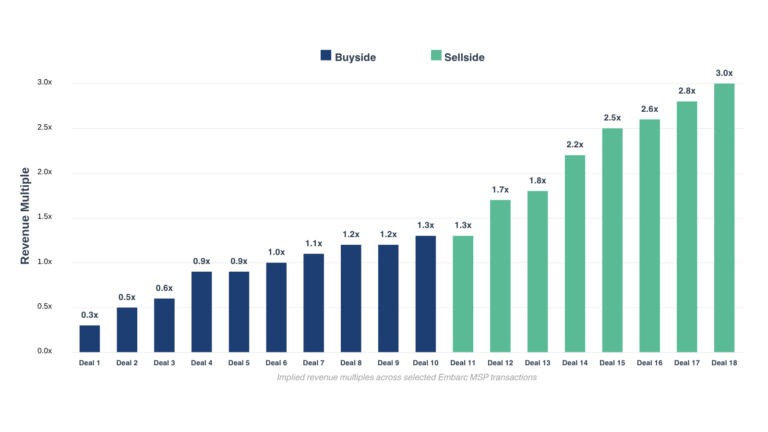
For more on what buyers look for in MSPs, see eight lessons for IT MSP providers from buyers and why revenue multiples matter for IT MSP valuations.
What Should You Do If You’re Not Selling Yet?
Start tracking these metrics now. A number with two or three years of consistent history tells a buyer far more than one you started tracking last quarter.
It also pays off before any sale. One of the first things private equity does after buying a company is put stronger financial leadership in place, so it can track metrics like these and act on them. You don’t have to wait for a buyer to get that benefit. A strategic finance or fractional CFO team can build the reporting and forecast now, so you’re running the business on these numbers well before you sell.
If your books need work first, start with getting your books exit ready.
Want to see how your MSP measures up?
Talk with Embarc Advisors about where you stand today, whether a sale is a year away or five.
Frequently Asked Questions
What metrics do buyers use to value an IT services company?
Buyers focus on eight: revenue growth, recurring revenue as a share of total revenue, customer retention, net dollar retention, gross margin by service line, adjusted EBITDA, customer concentration, and customer tenure. EBITDA sets the baseline, and the other seven largely shape the multiple.
Are MSPs valued on revenue or EBITDA?
Most MSP deals are priced as a multiple of adjusted EBITDA. Revenue multiples come up more often for fast-growing companies with a high share of recurring revenue, where current earnings understate what the business is worth.
What is net dollar retention?
Net dollar retention compares this year’s revenue from customers you had a year ago with what those same customers paid a year ago, counting upsells, downgrades, and churn. Above 100 percent means your existing customers are growing with you.
What is a good recurring revenue percentage for an MSP?
There isn’t a single cutoff. Buyers generally pay more as the recurring share rises, as long as the revenue is under contract, growing, and clearly separated from project work and product resale.
Should an MSP do its own Quality of Earnings before selling?
Usually, yes. The buyer will run its own QofE after the letter of intent, and it’s built to protect the buyer. A seller’s QofE finds legitimate adjustments first, so the multiple is applied to the full number, and it surfaces issues while you can still explain them.
When should an MSP owner start tracking these metrics?
As early as possible. Buyers trust a metric with two or three years of consistent history far more than one you started tracking right before going to market.