
Most financial plans are built on optimism. A credible forecast is built on evidence. Here’s the difference, and why it matters more than most business owners realize.
Benjamin Franklin said it plainly: if you fail to plan, you are planning to fail. But in practice, most business plans fail not because owners don’t have one, but because the plan they have isn’t believable enough to actually drive decisions.
With clean financials, upgraded processes, and the right KPIs in place, Step Four of the strategic finance framework is about building a plan. Specifically, a budget and forecast that goes beyond aspiration and is grounded in the actual drivers of the business.
That distinction matters. A budget is not the same as a forecast. And a forecast built on wishful thinking is not the same as one a potential acquirer, investor, or leadership team will actually believe. Getting this right is one of the highest-leverage things a growing business can do.
Start with a budget
A budget is the foundation of the planning process. It establishes your financial goals and lays out the assumptions behind them: how much revenue you expect to generate, what it will cost to deliver, and what you plan to spend to run and grow the business.
Building one requires working through several key components in sequence:
- Establish financial goals: What does success look like this year? Define targets for revenue, profitability, and cash.
- Outline revenue projections by product or service: Break revenue down by line so you can evaluate margin and growth assumptions at the source.
- Detail cost of goods: Understand the direct costs of delivering your product or service so gross margin is visible and defensible.
- List fixed and variable operating expenses: Separate what stays constant from what scales with revenue so you can model different growth scenarios.
- Include capital expenditures and debt obligations: Account for planned investments and financing costs so the cash picture is complete.
- Calculate profit and cash flow assumptions: Pull it together into a bottom line view that shows what the business will actually generate and when.
A well-built budget forces clarity. It requires you to articulate assumptions that are often left implicit, and it creates a baseline against which actual performance can be measured. That’s not just useful internally. It’s essential for any external conversation about the business.
Then build a forecast
A budget tells you what you’re planning. A forecast tells you what you’re predicting and why. The distinction is important because a forecast is built on historical evidence, not just future intention.
Once the budget is in place, the next step is to analyze historical financial performance to identify trends. What has revenue growth actually looked like over the past two or three years? What seasonal patterns exist? Where have costs consistently come in above or below expectation? Those patterns become guardrails for building a forward projection that’s grounded in reality rather than aspiration.
From there, the forecast layers in strategic context: planned growth initiatives, market or industry trends, and any known variables that will affect performance in the period ahead. A car dealership building a forecast in a rising interest rate environment, for example, needs to account for the likelihood that fewer customers will qualify for financing. A software company needs to consider how tighter client budgets might affect deal size and sales cycles. The forecast is only credible if it reflects the world the business is actually operating in.
What makes a forecast credible
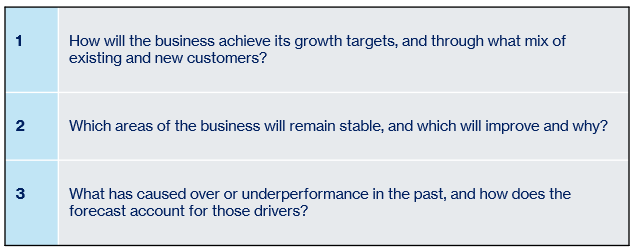
This is the part most businesses get wrong. A credible forecast isn’t just a spreadsheet with optimistic numbers. It’s a model that demonstrates how the business will achieve its growth targets, specifically accounting for the mix of existing customers and new ones, the areas of the business that will remain stable versus improve, and the factors that have historically caused over or underperformance.
That last piece is critical. Anyone can project growth. What separates a credible forecast from a wish list is the ability to explain every line. Why is revenue expected to grow 15% this year when it grew 8% last year? What changed? What’s driving that assumption? If the CFO can’t answer those questions clearly, the forecast won’t hold up to scrutiny and it won’t drive behavior internally either.
Three questions a credible forecast must answer
A plan without a number isn’t a plan
One of the most common failure modes in business planning is treating the budget as a one-time exercise. It gets built at the start of the year, presented to leadership, and then filed away until the next planning cycle. Meanwhile, the business keeps moving and nobody is tracking whether the plan is actually happening.
A budget and forecast only create value when they’re actively used. That means comparing actual results to the plan every month, understanding why variances occurred, and adjusting forward projections based on what’s actually happening in the business. That’s what Step Five is about and it’s where the real power of this framework starts to show up.
The budget gives you a target. The forecast gives you a basis for believing it. Monthly reporting is what keeps both of them honest.
Step Five in the Strategic Finance Framework is about the Monthly Reporting Habit: The Monthly Reporting Habit that Separates Growing Companies from Stagnant Ones.
Missed the first blog in the series? Learn Why Strategic Finance is the Growth Lever Most Companies Ignore.
For your own copy of the Strategic Finance Playbook, download it today.
Ready to pursue breakthrough growth?