
Most companies build a plan and then ignore it. Here’s what it looks like to actually use your financials to drive performance, month after month.
A plan that nobody measures against isn’t a plan. It’s a document. The businesses that grow consistently aren’t the ones with the best spreadsheets. They’re the ones that sit down every month, compare what happened to what they expected, and do something about the difference.
With a solid budget and forecast in place, Step Five of the strategic finance framework is where the real discipline begins. It’s one thing to build a plan. It’s another to execute against it, track your performance honestly, and use what you learn to make better decisions going forward.
Too many companies treat monthly financial reporting as a compliance exercise. Close the books, generate the statements, file them away. But reporting isn’t the destination. It’s the starting point for a conversation about what’s actually happening in the business and what to do about it.
The Budget vs. Actuals analysis
The cornerstone of monthly reporting is a Budget vs. Actuals analysis, commonly called a BvA. It’s a straightforward comparison of what you planned to happen against what actually happened, broken down by category.
A basic BvA looks at revenue, cost of goods sold, gross profit, operating expenses, and EBITDA. For each line it shows the budgeted figure, the actual figure, the variance in dollars, the variance as a percentage, and a brief explanation of what drove it.
Sample Budget vs. Actuals (BvA)
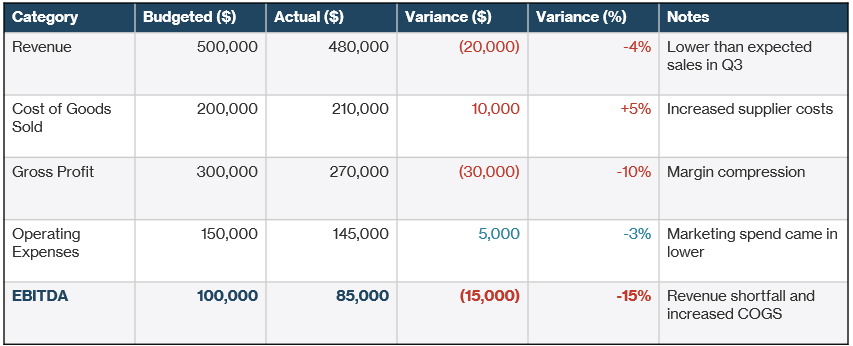
The table above is straightforward. What separates a useful BvA from a box-checking exercise is what happens after the numbers are on the page. The analysis has to go beyond the variance. It has to answer three questions.
The three questions every BvA must answer
- Why did we over or underperform in certain areas? Was it seasonality? A market shift? A pricing issue? A single large customer that skewed the numbers? Understanding the root cause matters more than the number itself.
- What actually happened? Were expenses higher because a supplier raised prices, or because a department overspent? Did revenue miss because of deal timing, or because the pipeline is thinner than expected? The CFO should be able to explain every line.
- How can we do better? Once you understand what happened and why, the conversation shifts to what changes. Is this a one-time issue or a pattern? Does the forecast need to be adjusted? Does the business need to make a different decision next month?
This is where monthly reporting earns its value. Not in the generation of statements, but in the quality of the conversation those statements enable. A CFO who can walk leadership through a BvA with clarity and insight is giving the business something it can actually act on.
Root cause analysis is the real discipline
Most businesses can identify that something went wrong. Fewer can explain precisely why. And fewer still use that understanding to build a better forecast for the months ahead.
Root cause analysis is the practice of digging past the surface variance to find the underlying driver. Revenue was down 4%. Why? Sales volume was lower than expected. Why? Two deals that were forecast to close in the month slipped to next quarter. Why? The sales cycle for enterprise clients is running longer than the model assumed. Now you have something actionable: a conversation about pipeline management, deal velocity, or whether the forecast assumptions need to be updated.
That chain of reasoning, from variance to driver to decision, is what separates companies that learn from their financials from those that simply report them. And the only way to build that capability is to practice it every single month, even when performance is strong.
What good monthly reporting looks like in practice
A well-run monthly reporting cadence has a few consistent elements. The close process wraps up within 10 days of month end, producing financial statements that are accurate and complete. The BvA is prepared alongside the statements, not as an afterthought. And a leadership review meeting is held within a week of the close to walk through performance, discuss variances, and align on any adjustments to the forward plan.
That meeting matters more than most leadership teams give it credit for. When it’s run well, it’s not a status update. It’s a decision-making session. The financial data is the agenda, the variances are the discussion points, and the outcome is a set of clear actions and adjusted expectations for the month ahead.
What a good monthly reporting cadence includes
+ Books closed within 10 days of month end
+ BvA prepared alongside financial statements, not after
+ Root cause identified for every material variance
+ Leadership review meeting held within a week of close
+ Forward forecast updated based on actuals and new information
+ Clear actions and owners assigned before the meeting ends
Why consistency is the whole game
The value of monthly reporting compounds over time. One month of BvA analysis tells you what happened. Six months tells you whether it was a pattern. Twelve months gives you the historical context to build a forecast that’s genuinely predictive rather than aspirational.
The businesses that do this consistently, month after month regardless of whether performance was good or bad, are the ones that develop real financial intelligence. They know their business at a level of detail that most competitors don’t. And that knowledge pays dividends whether the goal is growth, a capital raise, or an eventual sale.
The plan gets you started. The habit is what actually moves the needle.
Step Six in the series covers whether your organization is ready for growth: Is Your Organization Built for the Growth You’re Planning?
Missed the first blog in the series? Learn Why Strategic Finance is the Growth Lever Most Companies Ignore.
Download the Embarc Advisors Strategic Finance Playbook for the complete 7-step process, including templates, best practices, and real-world examples to help you build a finance function that drives growth.
Ready to pursue breakthrough growth?