
If you’re thinking about selling, the state of your financials will shape your outcome more than almost anything else. Here’s what buyers scrutinize first.
By the time a buyer makes an offer on your business, they’ve already formed a detailed opinion about how well it’s run. And a large part of that opinion comes from one place: your financials.
Owners often assume the offer is about the business’s performance. Strong revenue, healthy margins, a growing customer base. Those things matter. But what shapes an offer just as much, and sometimes more, is whether the buyer can trust and verify what they’re looking at.
Having sat on the deal side of many transactions, we can tell you that the financials do more than report performance. They signal how the business is run, how much risk the buyer is taking on, and how much work they’ll have to do after the close. All of that gets priced in.
Here’s what buyers look at first, and what it tells them.
They look at whether the numbers can be trusted
Before a buyer evaluates how good the numbers are, they evaluate whether they can believe them.
That means accrual-based accounting that matches revenue and expenses to the right periods. A chart of accounts organized well enough to analyze margins by product or service line. A month-end close process that produces consistent, timely financials. These aren’t sophisticated asks. But their absence is a red flag, because it suggests the reported performance may not reflect economic reality.
When a buyer can’t trust the numbers at face value, they do one of two things. They discount the offer to account for the risk, or they dig in with expensive, invasive diligence that slows the process and strains the relationship. Neither works in the seller’s favor.
They look at the quality of earnings
Buyers don’t just want to know how much the business earned. They want to know how much of that earning is real, repeatable, and transferable.
This is what a Quality of Earnings analysis examines. Are there one-time revenue events inflating the picture? Owner expenses running through the business that a new owner wouldn’t incur, or wouldn’t be able to eliminate? Customer concentration that makes future earnings riskier than the topline suggests? Revenue recognition practices that overstate performance?
A business with clean, well-documented, defensible earnings commands a higher multiple than one where the buyer has to guess how much of the profit is durable. The clearer your earnings quality, the stronger your position.
They look at whether the business depends on you
This one catches many owners by surprise. A business that runs entirely on the owner’s relationships, knowledge, and daily involvement is worth less than one that runs on systems and a capable team.
From the buyer’s perspective, an owner-dependent business is a risk. When you leave, what happens to the revenue tied to your relationships? To the decisions only you know how to make? To the institutional knowledge that never got documented?
The financials tell part of this story. A business with a real finance function, consistent reporting, and a management team that operates independently signals transferability. A business where the owner is the finance function, the sales team, and the strategic brain signals concentration risk.
They look at whether your forecast is believable
Buyers are buying the future, not the past. So your forecast matters enormously, but only if it’s credible.
A forecast built on defensible assumptions, grounded in historical performance and specific business drivers, gives a buyer confidence in what they’re paying for. A forecast that’s just an optimistic line pointing up and to the right does the opposite. It signals that the seller either doesn’t understand the drivers of their own business or is hoping the buyer won’t ask.
The ability to explain every assumption in your forecast, why growth will come from here, why margins will hold there, is one of the clearest signals of a well-run business.
What this means if you’re thinking about selling
The uncomfortable truth is that most of the value-affecting work happens before a buyer is ever in the picture. By the time you’re in a live process, the state of your financials is largely fixed, and you’re negotiating from whatever position that leaves you in.
The owners who achieve the best outcomes are the ones who prepared. They cleaned up the accounting, built a credible forecast, reduced owner dependence, and made sure their earnings could withstand scrutiny, all before going to market. The result is a faster process, fewer surprises, a stronger negotiating position, and a higher multiple.
If a sale is on your horizon, even a few years out, the time to understand where your financials stand is now, while you still have room to improve them.
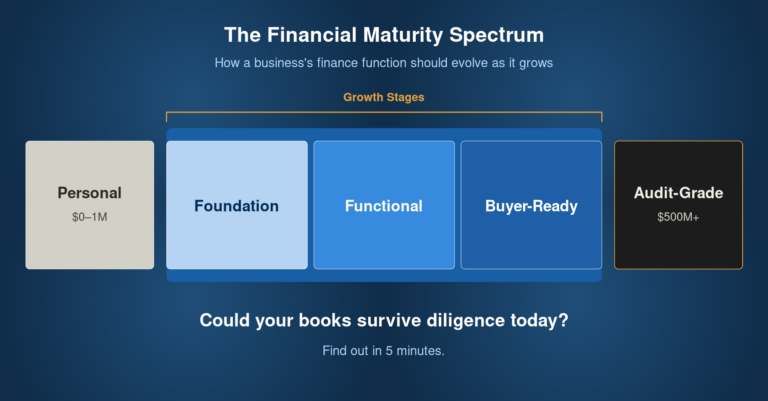
The Diligence Readiness Assessment is built for exactly this. It scores your finance function against the same standards a buyer applies, and shows you specifically where the gaps are. Ten questions, five minutes, and a report you can act on.
Take the Diligence Readiness Assessment